Physical Activity Guidelines for Adults: 150 Minutes a Week and Two Strength Days

The World Health Organization, the US Centers for Disease Control and Prevention and the NHS give adults essentially the same advice on physical activity: build up to at least 150 minutes of moderate activity a week, add muscle-strengthening activities on two or more days, and sit less. This guide explains what each part means, how to tell moderate from vigorous, and how to start if you are doing very little now.
The aerobic target
The CDC recommends that adults get 150 minutes of moderate-intensity activity a week, or 75 minutes of vigorous-intensity activity, or an equivalent mix of the two. The NHS gives the same figures for adults aged 19 to 64 and suggests spreading activity evenly over four to five days a week, or every day. The WHO's 2020 guidelines express the target as a range, 150 to 300 minutes of moderate or 75 to 150 minutes of vigorous activity a week, with additional benefits from doing more.
A minute of vigorous activity counts roughly double a minute of moderate activity. The NHS says that, in general, 75 minutes of vigorous activity can give similar health benefits to 150 minutes of moderate activity. Short, very intense bursts with rests, such as interval training, can also contribute.
The WHO estimates that 31% of adults worldwide, about 1.8 billion people, do not meet the recommendation of at least 150 minutes of moderate activity a week.
How to judge intensity
You do not need a heart-rate monitor. The NHS describes simple tests:
- Moderate: your heart beats faster, you breathe faster and feel warmer, and you can still talk but not sing. Examples: brisk walking, water aerobics, cycling, dancing, doubles tennis, pushing a lawnmower, hiking.
- Vigorous: you breathe hard and fast and cannot say more than a few words without pausing. Examples: running, swimming, cycling fast or on hills, walking up stairs, most team sports, skipping, aerobics, martial arts.
Intensity is personal. For someone who has been inactive, a brisk walk may be vigorous; for a regular runner it is light. The talk test adjusts automatically.
Strength on two days
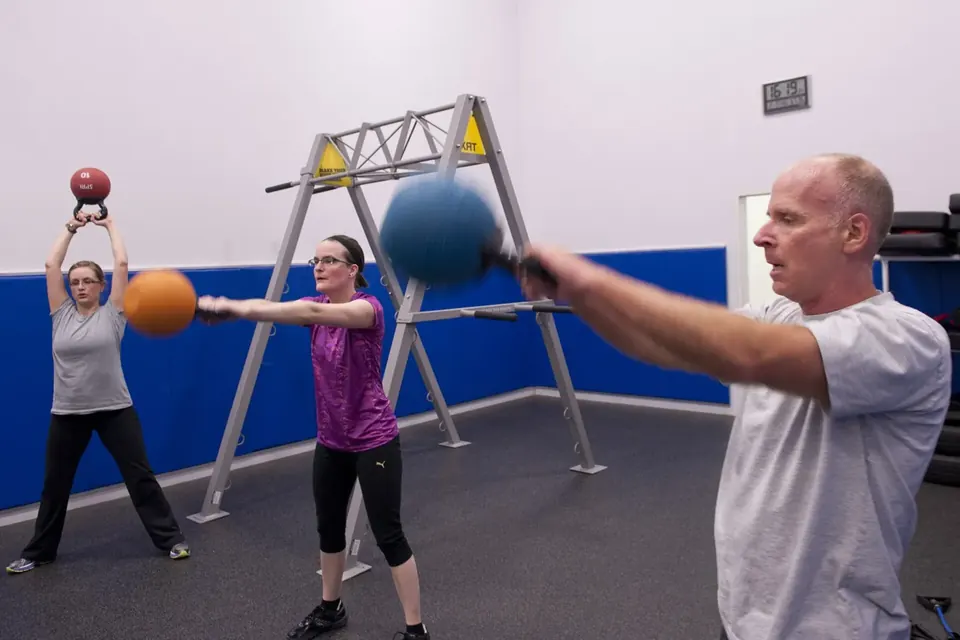
All three bodies recommend muscle-strengthening activities that work the major muscle groups (legs, hips, back, abdomen, chest, shoulders and arms) on at least two days a week, in addition to the aerobic target. The NHS lists many options beyond the gym: carrying heavy shopping, yoga, pilates, tai chi, lifting weights, resistance bands, body-weight exercises such as push-ups and sit-ups, heavy gardening, wheeling a wheelchair and lifting children. To benefit, it suggests doing them to the point where you need a short rest before repeating. Our guide to muscle-strengthening activity for beginners goes further.
Sit less
The guidelines also ask adults to reduce time spent sitting or lying down and to break up long periods of not moving. The WHO links higher amounts of sedentary behaviour in adults with higher all-cause, cardiovascular and cancer mortality and with more cardiovascular disease, cancer and type 2 diabetes. Practical ideas include standing or walking during phone calls, taking the stairs, getting off public transport a stop early and setting a reminder to stand up every half hour or so at a desk.
What activity does for health
According to the WHO, regular physical activity in adults and older adults is associated with lower risk of death from all causes and from cardiovascular disease, less high blood pressure, fewer cases of type 2 diabetes and some cancers, fewer falls, and better mental health, cognitive health and sleep. It notes that people who are insufficiently active have a 20% to 30% higher risk of death than people who are sufficiently active. Activity also helps manage weight, but its benefits do not depend on weight change; they apply at every size.
Starting from zero
The CDC's message is that some physical activity is better than none, and the WHO says all physical activity counts. If 150 minutes sounds far away, start with what is realistic:
- Begin with walking. The NHS points out that a brisk 10-minute daily walk already counts towards the 150 minutes. See walking for health.
- Add a little each week. An extra 5 to 10 minutes a day, or one extra session a week, is a sustainable pace.
- Use your journeys. Walking or cycling to work, school or the shops builds activity into the day without extra time. The WHO counts activity for transport alongside sport and leisure.
- Pick something you enjoy. Dancing, swimming, gardening or a team sport are more likely to last than an activity you dread.
- Bring in strength. Two short sessions of body-weight exercises a week are enough to start.
The NHS advises speaking to a GP first if you have not exercised for some time or have medical conditions or concerns, and making sure the activity and its intensity suit your fitness.
Special situations
- Older adults: the same aerobic and strength targets apply, and the WHO adds activities that combine balance and strength on three or more days a week to help prevent falls.
- Pregnancy and after birth: the NHS says the adult guidelines are suitable for pregnant women and new mothers, with adjustments; vigorous activity is not recommended if you were inactive before pregnancy.
- Disability and long-term conditions: the NHS states the guidelines are suitable for disabled adults, and the WHO has specific recommendations for people with chronic conditions and disabilities. A physiotherapist or doctor can help adapt them.
Where you live makes a difference too: safe pavements, parks and cycle routes make it far easier to be active every day. We look at that in how where you live shapes how much you move.
Sources
- World Health Organization, "Physical activity" fact sheet.
- Centers for Disease Control and Prevention, "Adult Activity: An Overview".
- NHS, "Physical activity guidelines for adults aged 19 to 64".
- World Health Organization, "WHO guidelines on physical activity and sedentary behaviour" (2020); US Department of Health and Human Services, "Physical Activity Guidelines for Americans", 2nd edition (2018).
 Physical activity
Walking for health
A brisk 10-minute walk already counts. What brisk means, whether 10,000 steps is official, and how to make walking part of every day.
 Physical activity
Strength activity for beginners
Strength exercises on two days a week, as the guidelines recommend: what counts, simple moves to start at home, and how to progress safely.
 Physical activity
Moving to a new city and staying active
Walkable streets, parks within reach, a commute on foot or by bike, a gym or pool nearby and a quiet bedroom: what to check before choosing where to live.